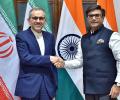
India's Foreign Secretary Vikram Misri will travel to Beijing for a two-day trip beginning Sunday, marking the second high-profile visit from India to China in less than one-and-a-half months. The visit comes amidst ongoing border tensions and follows a recent disengagement pact between the two countries in eastern Ladakh. The Foreign Secretary-Vice Minister mechanism meeting will focus on the next steps for India-China relations, including in the political, economic, and people-to-people domains. The decision to revive this bilateral mechanism was taken at a meeting between Prime Minister Narendra Modi and Chinese President Xi Jinping in Kazan in October.
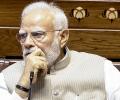
China welcomes Prime Minister Narendra Modi's planned visit to the Tianjin Summit of the Shanghai Cooperation Organisation (SCO), expressing hope that the event will be a 'gathering of solidarity, friendship and fruitful results'.

If Beijing succeeds in this multipronged effort to challenge the current dominant power, it will have not just economic but political and security consequences. There is no let-up in the South China Sea nor any de-escalation moves on the India-China border. This portends to ominous signalling from Beijing, observes China expert Srikanth Kondapalli.

Since the Pahalgam terrorist attack, China, Pakistan's "ironclad ally", while condemning it, has called for restraint, besides a fair and swift investigation into the attack.

Modi arrived by a special flight from Delhi and was received by Tamil Nadu Governor Banwarilal Purohit and Chief Minister K Palaniswami among others.
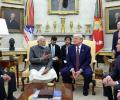
'As one former Indian diplomat put it to me, Delhi has access to the White House, but Islamabad has access to Mar-a-Lago.'

Japan is expected to increase its investment target in India from the earlier 5 trillion yen ($34 billion) to almost 10 trillion yen.

Xi commended the battalion members for their remarkable efforts in guarding China's border region, noting that they have dedicated their youth to securing the country's territorial integrity and have accomplished their missions well, state-run Xinhua news agency reported.

Chinese Foreign Minister Wang Yi said that it is imperative for the two sides to view each other as partners and opportunities rather than rivals or threats, and invest their valuable resources in development and revitalisation.

Beijing was caught by surprise as Kishida, who was on an official visit to New Delhi from March 19-21, entered Poland from India using a secretly chartered plane instead of the standard government aircraft, Japanese TV channel NHK reported.

As it gears up to host Chinese President Xi Jinping, India on Monday said it expects that the visit will address the "interests and concerns" of the two countries and that "all substantive" issues having bearing on the ties including the boundary dispute will be discussed.
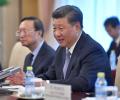
Xi said China is ready to work with Pakistan to forge a closer China-Pakistan community of shared future in the new era.
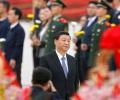
Wang Junzheng, Tibet's new Communist party boss, is on a number of sanctions lists by the US, Britain, the EU and Canada, for his tough role in Xinjiang, aimed at China's Uyghur ethnic minority, observes Jayadeva Ranade, the retired senior RA&W officer and distinguished China expert.
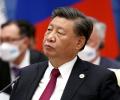
Xi Jinping's recent actions in South Asia have amply demonstrated the disastrous impact of China's embrace, observes Jayadeva Ranade, the retired senior RA&W officer and China expert.

Chinese President Xi Jinping will arrive in Pakistan on Monday on a two-day visit to deepen economic and strategic ties between the two "all-weather" allies.
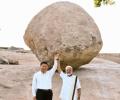
'My understanding is that by the time President Xi Jinping came for the Chennai summit [2019], he had already instructed his army to undertake the action in Galwan in the summer of 2020.'

Considering Modi's style of practicing diplomacy, it is likely that a clear message would be conveyed to China that it is high time Beijing stops using its good relations with Pakistan as a pressure tactic against India. This is imperative not only for strengthening India-China relations at the bilateral level but also for maintaining stability at the regional level, says Sana Hashmi.

China is also ready to promote high-quality Belt and Road Initiative cooperation, and push for new progress in the future-oriented, all-round friendly and cooperative partnership between the two countries, she added.

'The Ladakh clashes are mere warning signals of the storm to come on May 22 when the Chinese parliament meets,' observes Colonel Anil A Athale (retd).

National Security Advisor Ajit Doval stated that India-China relations have shown an "upward trend" in the past nine months, with peace prevailing along the Line of Actual Control (LAC). This statement was made during talks with Chinese Foreign Minister Wang Yi on the boundary issue, ahead of Prime Minister Modi's visit to China for the SCO summit.
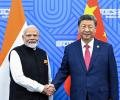
The Galwan clash occurred six months after the Doklam disengagement and two high-profile meetings. India should not be caught by surprise once again, asserts former foreign secretary Shyam Saran.

'The MEA, hopefully, made it clear that the Indian PM can't be seen in Xi Jinping's company when China has, for all intents and purposes, annexed over 1,000 sq kms of Indian territory in eastern Ladakh, and essentially that the Wuhan spirit and the Mamallapuram spirit have turned into vinegar.'
Xi will later head for New York to attend the UN General Assembly session.
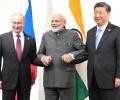
It will be Putin's first participation in a multilateral summit after a mercenary group launched a short-lived armed rebellion last week that rocked Moscow.
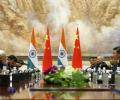
Prime Minister Narendra Modi began a three-day visit to China from this north west city on Thursday, the hometown of Chinese President Xi Jinping with whom he held "very substantive" discussions focussing on strengthening of mutual trust and the boundary issue.

Ahead of the India-China summit, Mahabalipuram, the ancient coastal town near Chennai, has been virtually turned into a fortress with unprecedented security arrangements while the beautification and other preparations touched a feverish pitch on Wednesday.
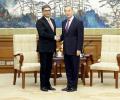
Foreign Secretary Vikram Misri on Monday called on Chinese Foreign Minister Wang Yi and discussed issues of bilateral interest.
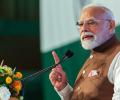
Prime Minister Narendra Modi on Friday said it is important for India and China to work together to bring stability to the world economic order as he asserted that New Delhi is ready to advance bilateral ties from a strategic and long-term perspective based on mutual respect, mutual interest and mutual sensitivity.

New Delhi 'will have to take a call which supply source suits us the best,' the finance minister said, pointing out that crude oil accounts for the bulk of India's foreign exchange spend.

Defence Minister Rajnath Singh has conveyed to his Chinese counterpart Admiral Dong Jun that India and China should maintain the positive momentum in the bilateral ties and avoid adding new complexities.

Sino-India ties have been taken on an upward trajectory by the recent visits of Chinese President Xi Jinping and Prime Minister Narendra Modi, top Chinese leader Zhang Dejiang said on Sunday.

Chinese President Xi Jinping arrived in Islamabad on Monday on his first visit to Pakistan where he is expected to sign a deal for an economic corridor worth $46 billion and other agreement.
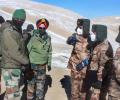
The talks are following up the outcome of the 19th round of Corps Commander-level talks held between the two sides on August 13-14 at the Chushul Moldo border meeting point.

Prime Minister Narendra Modi's bilateral meetings on the sidelines of the BRICS summit in Johannesburg are being finalised, Foreign Secretary Vinay Kwatra said on Monday but did not give a direct reply on the possibility of a meeting between Modi and Chinese President Xi Jinping.

'Just as we cannot surrender the interests of our farmers and dairy industry, Trump is also looking for markets for the produce of the farmers in the Midwest, which are his support base.'

At a press briefing on Xi's recent visit to India and Nepal, Chinese Foreign Minister Wang Yi said, "Both India and Pakistan are friendly neighbours of China, and the Chinese side hopes that the two countries can properly manage and control differences and improve their relations."
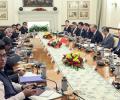
Chinese Foreign Minister Wang Yi's visit to India focuses on border talks with NSA Ajit Doval, amidst efforts to rebuild relations after the Galwan Valley clashes and rising India-US tensions.
Pakistan's last military parade was held on March 23, 2008.
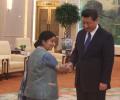
Chinese President Xi Jinping on Monday received External Affairs Minister Sushma Swaraj

Industry insiders expect Chinese tourists coming to India to double in around two years.
